Wrists: Difference between revisions
Jump to navigation
Jump to search
Tom Sgouros (talk | contribs) |
|||
| (9 intermediate revisions by 2 users not shown) | |||
| Line 7: | Line 7: | ||
==Overall Pipeline== | ==Description of Overall Pipeline== | ||
#[[Data]] | #[[Data]] | ||
| Line 19: | Line 19: | ||
#[[Joint Simulation]] | #[[Joint Simulation]] | ||
==Specific Tools and Technical Details== | |||
#[[Registration of Bones Across Positions#Technical Notes|registration]] | |||
#[[registration]] | |||
#[[joint space area calculations]] | #[[joint space area calculations]] | ||
#[[cartilage building]] | #[[cartilage building]] | ||
#"wiggling" bones around | #"wiggling" bones around | ||
#ligament length measures | #ligament length measures | ||
[[Wrist Pipeline Technical Details | Technical Details on Wrist Pipeline and its relationship to the $G software framework]] | |||
Latest revision as of 21:11, 9 April 2014
The wrist is a diarthrodial anatomical joint consisting of 8 small bones (scaphoid, capitate, hamate, lunate, trapezium, trapezoid, triquetrum, pisiform) and 7 long bones (radius, ulna, and 5 metacarpals). When subject to injury and disease the wrist undergoes changes in kinematics, inter-bone joint space areas, cartilage thickness, length of ligament paths, etc. Developing computational tools for the analysis of anatomical joint characteristics is important in understanding the cause of injury, tracing the progress of disease, and taking preventative measures.
-
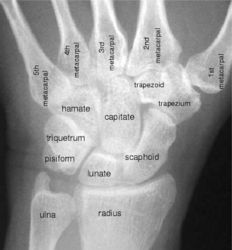 X-ray of the wrist with bone names
 -
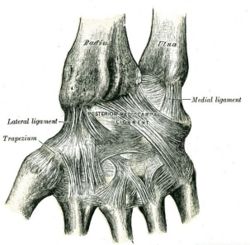 Ligaments: posterior view of left wrist


Description of Overall Pipeline
- Data
- Bone Surface Extraction
- Registration of Bones Across Positions
- Retrieval of Kinematics
- Inter-bone Joint Space Area Calculations
- Ligament Path Calculations
- Cartilage Maps (location & thickness)
- Cartilage Surface Deformations
- Joint Simulation
Specific Tools and Technical Details
- registration
- joint space area calculations
- cartilage building
- "wiggling" bones around
- ligament length measures
Technical Details on Wrist Pipeline and its relationship to the $G software framework